


Play as Selene, a witch embarking on an urgent quest to save her village from decimation and seek her brother amid the Cataclysm which awakened Malocchio, an ancient occult blight.
Genre: Adventure, Combat, Narrative.
Engine: Unreal Engine 5
Team size: 24 people
Duration: 8 weeks
Period: may - june 2026









Context
Malocchio was the final project of the 3rd year at ISART Digital. The goal was to create an Adventure game combining exploration, combat, platforming, with a strong narrative focus. The imposed artistic theme for Artists was Italy.
It was one of the largest student projects, with a team of 6 Game Designers, 4 Gameplay Programmers, 9 Game Artists, 3 Programmers, and 2 Sound Designers.


My roles
Since there were 6 Game Designers on the project, my main role was Level Design, where I was responsible for 1/3 of the level.
I also contributed to the overall Game Design of the game and Combat Design system.
In addition, I took on a Producer role to help with project organization and teams coordination.
Towards the end of production, I was responsible for QA test.
Screenshots


My Roles
Level Design





Top View
Level Flowchart


At the pre-production, I was responsible for designing the level flowchart and its macro progression:
I started by identifying the typical locations for the village, matching the storytelling: forest, village entrance, cemetery, church...
For each location, I assigned a gameplay situation: tutorial, pause, combat sequence, arena, and platforming. I then arranged them to create a balance of intensity and variety.
With the limit of 10 minutes of gameplay, I estimated the approximate duration of each situation.
With a lot of mechanics and enemies to introduce, I had to plan the timing and order of each tutorial.
In collaboration with the narrative designers, I placed narrative elements throughout the level at appropriate intervals, ensuring a good balance of gameplay and storytelling.

Environmental Storytelling
At the beginning of the level, Selene passes through a vista overlooking the village and its church, surrounded by a spiritual tornado.
This allows the player to understand where the tragedy originates and communicates the main objective they need to reach. It also serves as foreshadowing for the final arena.

Narrative Vista:
"In 1783, a family of witches was exiled from a small mountain village in Italy. In the absence of the witches, the villagers stopped performing funeral rites, causing the evil of the damned to accumulate within the soil of the village.
Elio, whose family had been exiled, decides to return to help the village. However, he accidentally summons an ancient demon named Malocchio, which possesses him and awakens the spirits buried beneath the village, unleashing chaos upon the area.
Selene, Elio's older sister, returns to the village to save her brother and stop Malocchio's cataclysm."
Story Pitch:


Dissipated Village:
I wanted to show the impact of the cataclysm on the environment. The earthquake has destroyed parts of the village, creating cracks in the ground that increase progressively toward the church. These cracks serve both narrative and gameplay purposes.
Some areas contain tombstones and crosses, suggesting that the villagers neglected their funeral rites, what caused the cataclysm.
This environment was achieved thanks to strong communication and collaboration with the Game Artists, who understood the level intentions.
Narrative Items:


We have included narrative items throughout the level. When interacted with, it displays an illustration and play a Selene voice lines.
These collectibles encourage the player to explore the level further and discover more of the story. The illustrations reveal narrative elements about Elio, showing his character and the origins of the cataclysm, while Selene's accompanying voice lines convey her feelings toward these events.

Level Design Techniques
1) During playtests, players would accidentally fall because they did not understand the edge of the crack. To prevent this, I placed an invisible block slightly beyond the edge.
2) Added a lighting effect to create stronger contrast and make the depth of the crack more visible.
3) Placed destructible barrels to guide the player toward the direction of the dash.
4) Placed a soul spawner that gives the player the jump ability while also indicating the direction.
5) The fence contrasts with the lighting of the crack, indicating that the player should jump rather than dash.
1) I created the enemy waves using the EnemySpawner tool, requested from the programmers.
2) Four spawners placed in each corner ensure a dynamic combat, with surrounding enemies.
3) The destructible barrels create a changing battlefield as the fight progresses.
4) Two small islands only spawn shooter enemies. The player is forced to dash or jump to kill them.
5) The barrels scattered throughout the arena can be destroyed during combat, making the fight more natural and dynamic.
1) A narrative item is placed at the highground and emits light to attract the player's.
2) The player has to climb to reach the narrative item.
3) The destructible barrels in a corner hides a soul that grants the ability to jump, providing a faster way to reach the item.
4) The character's camera is orthographic, so the character can hide when standing behind a wall. I therefore placed an invisible block to prevent the character from getting too close to the wall to ensure they remain visible to the player.
Platformer situation:
Combat arena:
Narrative item:


I was responsible for the final section of the level, so clear communication between the Level Designers was essential to maintain consistent pacing and difficulty.
I also playtested the other Level Designers' sections and provided feedback and suggestions to help improve them.

Blockout Production
1) Paper design of the gameplay situations in Figma, following the locations in the Level Flowchart.
2) Blockout and iterations of the situations in Unreal Engine, following the 3C metrics.
3) Creation of enemy waves for the arena using the EnemySpawner tool.
4) Placement of trigger zones (camera, voice line, arena), narrative items, and destructible barrels.
5) Organization of playtest sessions. I documented feedbacks and implemented the relevant changes.
6) Collaboration and communication with Environment Artists, pointing out areas that needed changes to improve the game's readability, guidance, and storytelling.
7) Level optimization and correction of softlocks (see below).
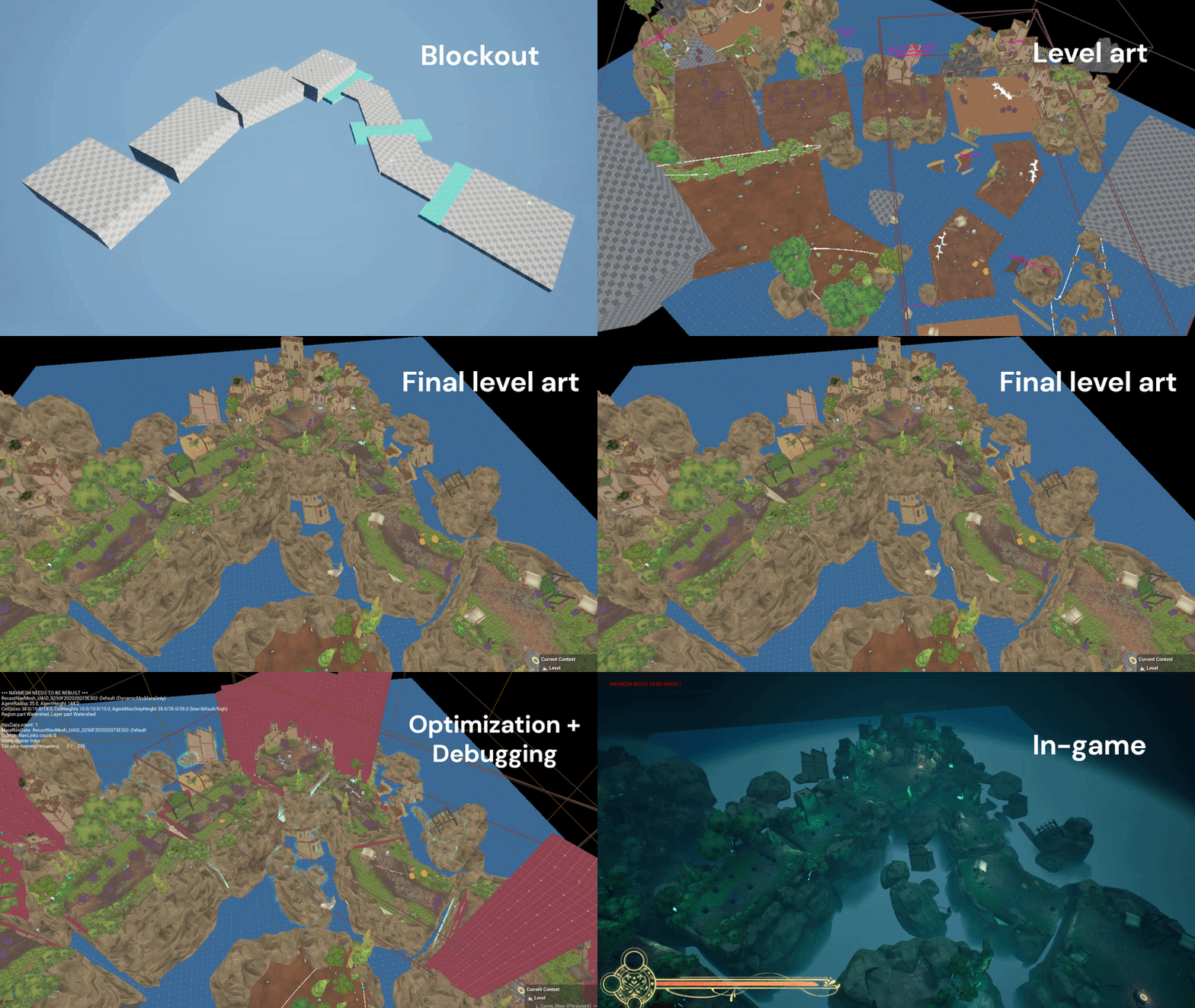
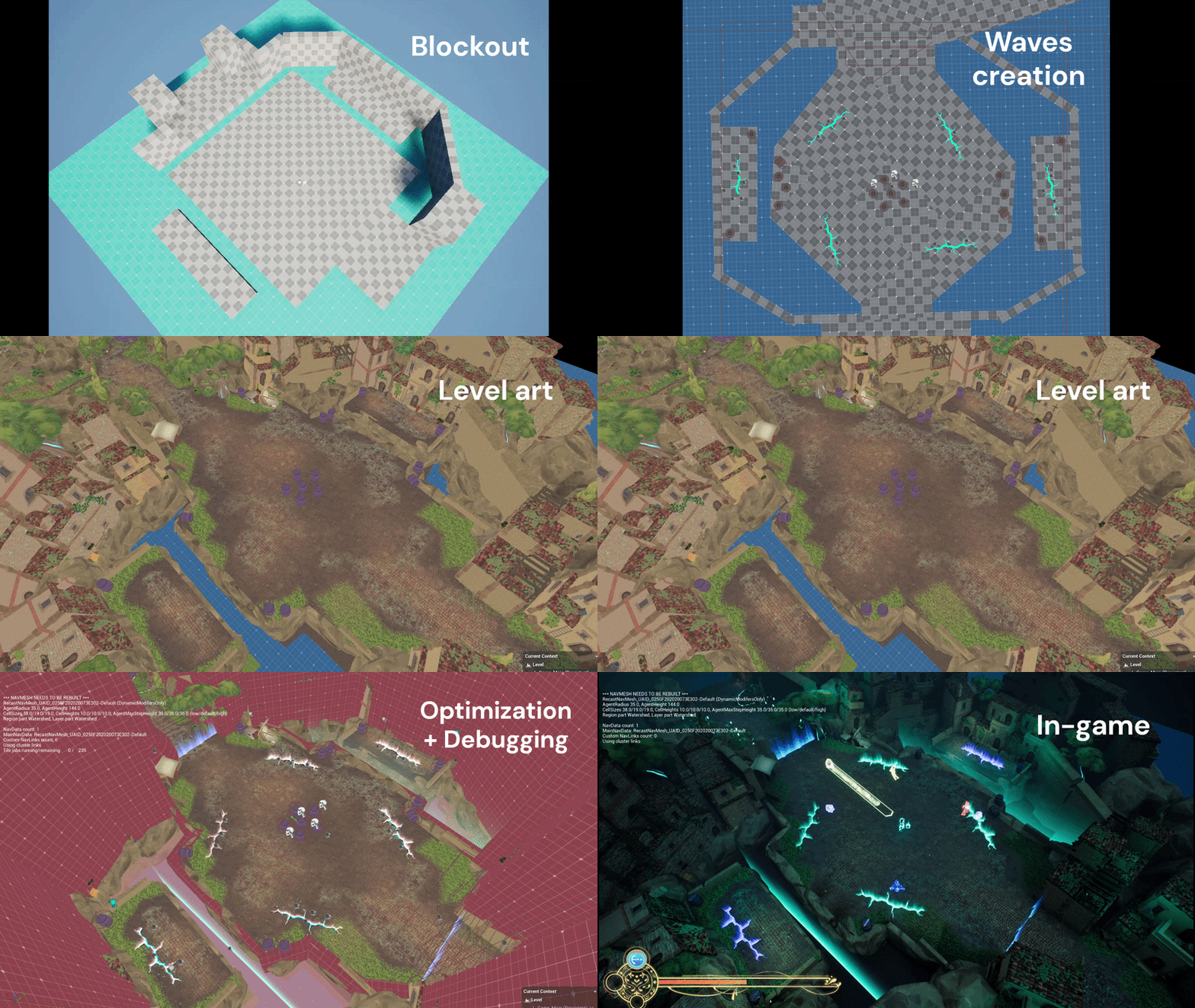
We were 3 Level Designers working on the game. I was responsible for designing and blocking out one third of the level. I created 1 platforming situation, 1 combat arena, and 2 pauses situation, including 1 with a narrative item.
Steps of production:


Collaboration with other Level Designers:


Optimization
I optimized the level by removing unnecessary mesh collisions and by placing of invisible walls to block the player from leaving the level.
I identified and resolved softlock areas by removing or adding collisions.
The overall FPS was improved through optimization, stabilizing the game at 60fps.
Game Design


My second role was Game Design. We were 6 Game Designers, and everyone work on the game's overall design.
I had the opportunity to work on different documentations:
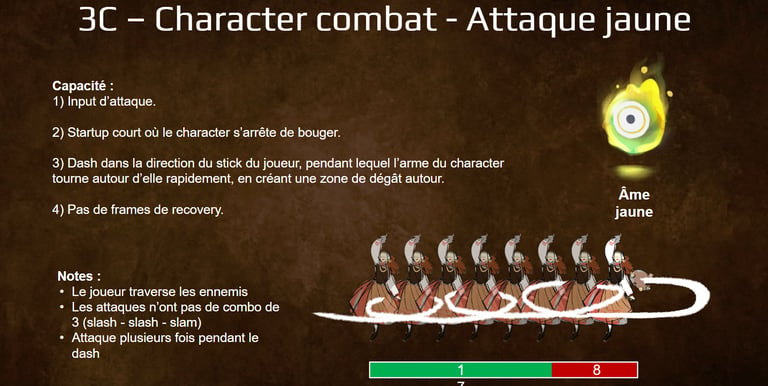
3C Technical Design Document: Camera (settings, contextual camera); Character (locomotion, attacks, blocking); Controls.
Combat Design Document: Character (attacks, blocking, special attack, 3 different Souls); Enemy Design (enemy popcorn, big enemy, 3 different Souls); Arena waves system.
Game Concept Document: Pitch; 3C; Combat Design; Enemies; Boss Design; Narrative; Level Design; UI/UX.
Documentations

Combat Design

There is a popcorn enemy, a big enemy, and 3 types of Souls: Red, Blue, and Yellow. Both the player and enemies can absorb these Souls to inherit their abilities. The goal was to make each Soul correspond to a specific combat/gameplay style, requiring different player skills and creating greater variety during combat.
Red Soul: Based on creating marks on the ground that deal damage again after a short delay. It encourages close-range combat and rewards good timing.
Blue Soul: Based on projectiles fired through attacks, either in a straight line or in a shotgun spread. It encourages ranged combat and requires good distance management.
Yellow Soul: Based on dashes that deal damage when passing through. It encourages a dynamic combat style that requires dexterity and reflexes.
The player and enemies share the same Soul abilities, which simplifies the player's understanding of the combat system and makes implementation easier for the programmers.
The game was developed over 8 weeks by a team of 6 Game Designers, 4 Gameplay Programmers, 9 Game Artists, 3 Programmers, and 2 Sound Designers, for a total of 24 people. I volunteered to take on one of the Producer roles to help the team with project organization and coordination.
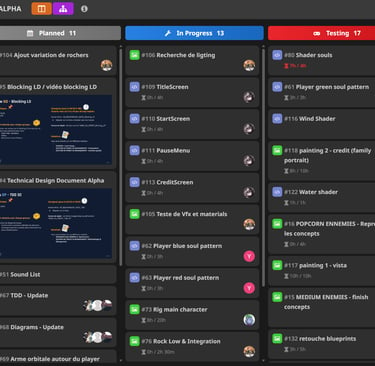
The backlog was organized in HacknPlan using tickets to track tasks.
To properly organize deliverables and sprints, I created a Google Sheet containing the project schedule, deliverables, and deadlines.
I organized weekly meetings between the different teams to review priorities and track the progress of each discipline.

Producing


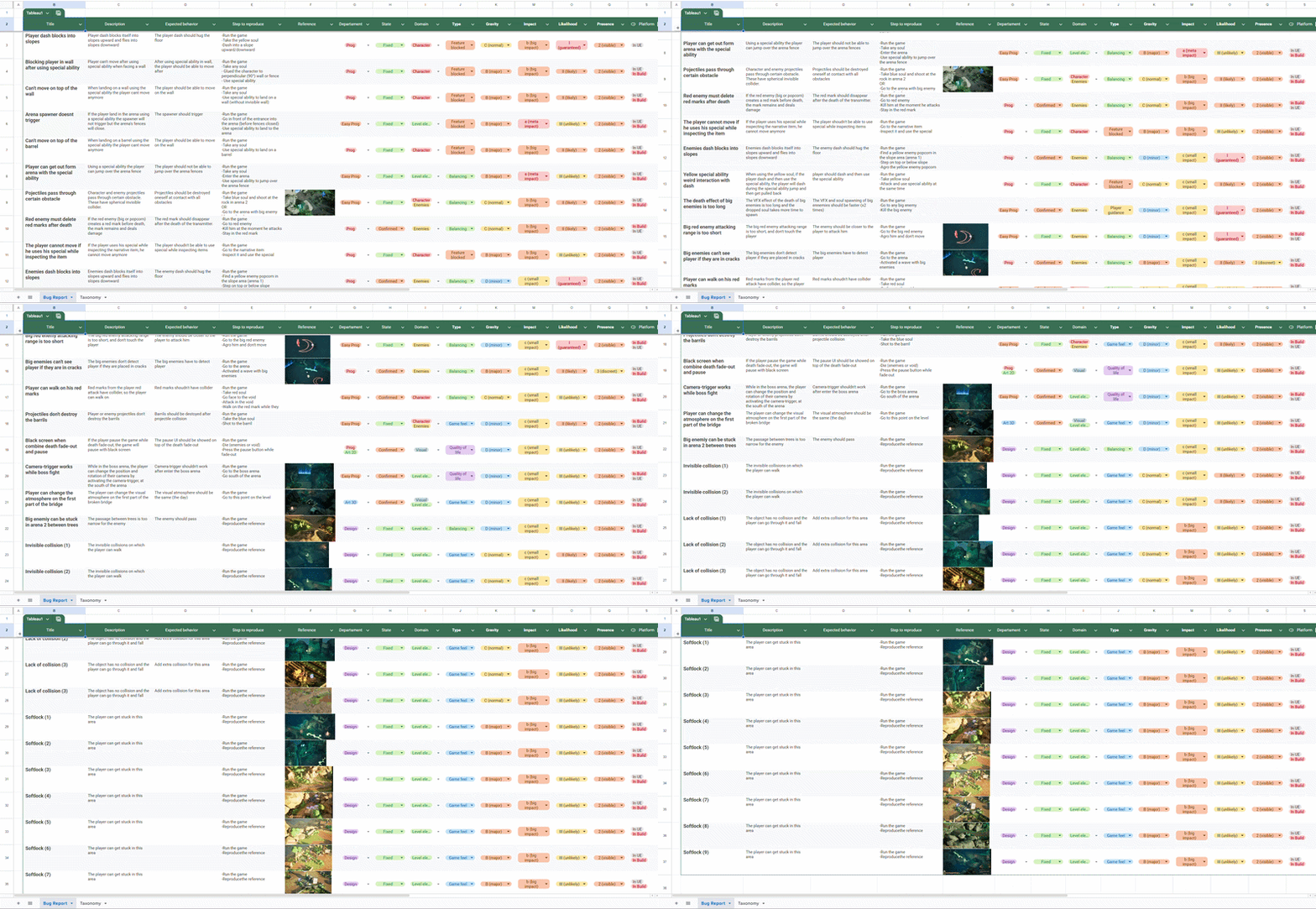
I created a bug report list for the team, including guidelines and explanations of the reporting process.
Identification of bugs and softlock in the game through various testing methods: Happy Path, Negative Testing, End-to-End Testing, and Boundary Testing.
Documentation and detailed reporting of bugs in english, including the description, expected behavior, steps to reproduce, and reference images.
Determination of bug priority based on type, gravity, impact, likehood, and presence.
Quality Assurance


Walkthrough

Credits