


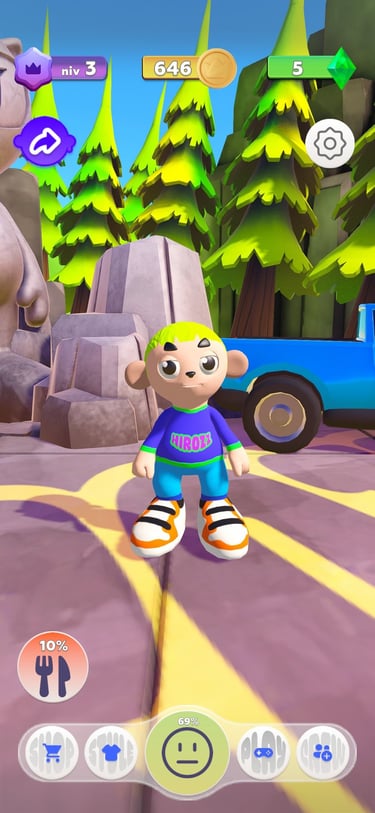
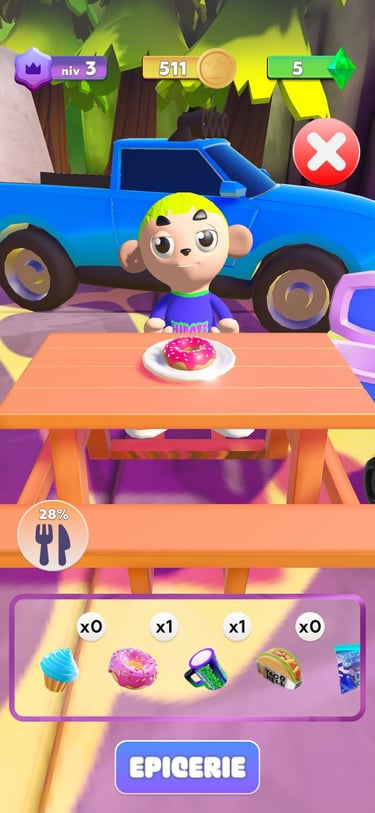
Hirozz is your pocket companion. Help your hero evolve by feeding and playing with them. Customize their appearance to stand out from other players. Challenge other players in strategic card battles.
Genre: Tamagotchi, Card Game, Mini-Games
Engine: Unity
Studio: Pletory
Duration: 2 months
Period: february - march 2026











Context


My roles
My main role was Game Design, focusing on improving the combat system, creating mini-games, and handling the game’s economy by balancing systems.
I also worked on the game’s UI and made various UX improvements. I also had the opportunity to do User Research by organizing playtest sessions.
In April 2026, I completed a 2 months internship as a Game Designer at Pletory, a small indie studio based in Paris, working on their mobile game Hirozz, available on Google Play and the Apple App Store.
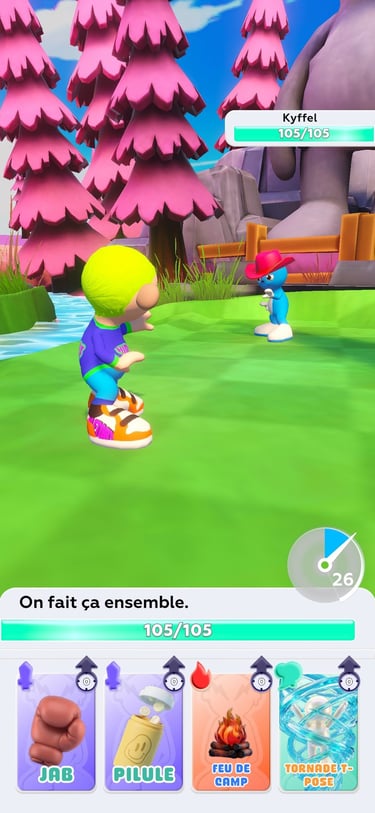
Hirozz is a Free-to-Play game that combines the Tamagotchi genre with a card game. The goal is to take care of your Hirozz by feeding it, playing with it, and battling other players. Battles take the form of a strategic card game featuring a deck-building system.
Screenshots
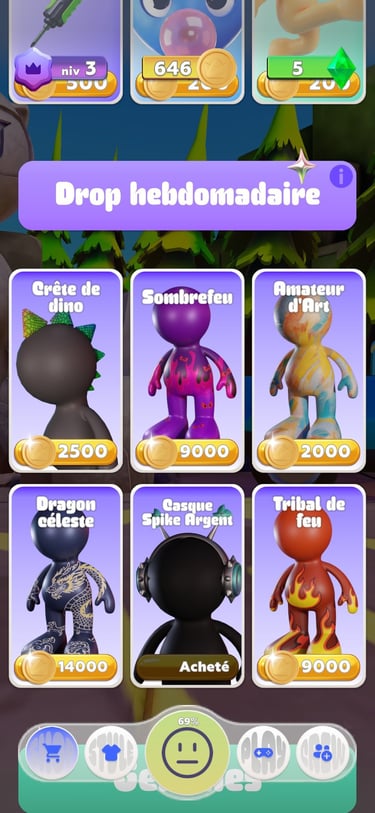
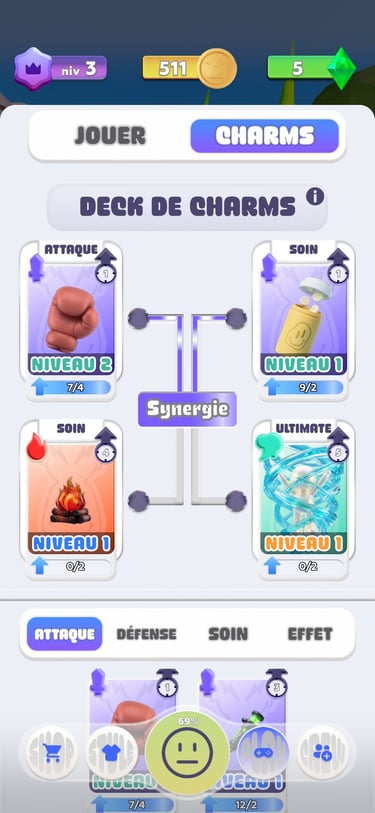
My Roles
Game Design


The game had several problems with its combat system.
My mission was to identify problems, propose solutions, and design a new combat system.
First, I identified the problems using my “Why-So” method. Starting from a problem, I ask myself “Why?” and “Where does this problem come from?” I then find the answer to use it to questioning and dig deeper into the cause. Finally, I conclude with “So” to identify the negative consequences of the problem. It allowed me to determine effective solutions for multiple problems.
Problems Solving


I created a document with all the possible solutions to improve the combat system. After approval from my Game Director, I designed the new system as a Paper Design, allowing for quick testing and iteration. Through playtests from User Research sessions, I identified further improvements and changes for the system.
I then created the full documentation for the new combat system, detailing and summarizing each of its elements.
Finally, I balanced the stats of the attack, defense, and healing cards using an Excel spreadsheet.

Card Game Design

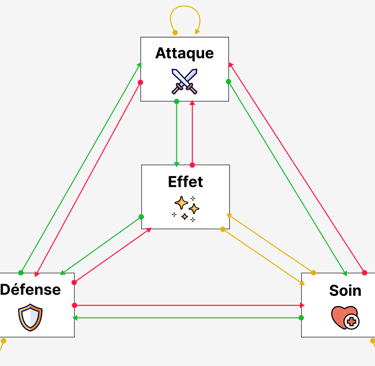


Attack, defense and healing cards system
Balancing of cards stats
Old combat system

Casual Mini-Games


Connecube is a puzzle game inspired by Tower of Hanoi and Connect Four.
The goal is to move the cubes and stack them in the correct order to progress to the next level.
I created a total of 125 levels across 5 difficulty levels, designing a progressive difficulty curve.
Connecube
Jetpack
Jetpack is a game inspired by Jetpack Joyride.
The player taps the screen to fly while avoiding obstacles. They must collect energy to refill their stamina gauge, to keep flying.
I created several obstacle patterns with varying levels of difficulty, which are combined procedurally to create different gameplay sequences.
To diversify the gameplay, I was tasked with designing several casual mini-games.
I made a market analysis and benchmarked to identify the performing mobile games genres.
For each mini-game, I created detailed documentation for the Programmer. Once the prototypes were completed, I worked on the level design and balancing.


Food Fall is a game inspired by Fruit Ninja.
Different types of food fall from the sky, and the player must connect matching pairs by drawing a line before they hit the ground.
I designed the entire random food spawning system.
Food Fall
Only Up
Only Up is a game inspired by one of the mini-games in Pou.
The goal is to climb as high as possible by jumping left or right onto the correct platforms. If the player chooses the wrong platform, they fall. The player must collect timers to gain additional time.

Eco Design


I designed the game’s entire economic system, game loops, and macro progression, creating several design documents. I also worked on balancing the game’s economy using Excel spreadsheets.
I designed and documented several systems:
Currency Flow (Soft & Hard Currencies)
XP Level Progression and XP Gain
Happiness and Hunger system
Combat and Mini-Game Rewards
Loot Box costs, drop rates and rarity
Card & Cosmetic costs, drop rates and rarity
Daily Quests

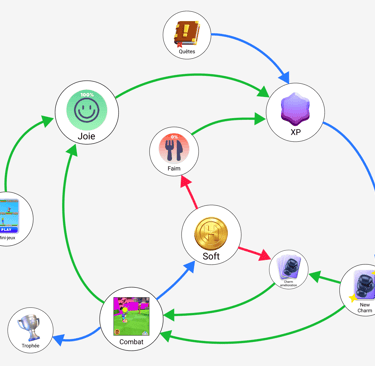


Soft & Hard Currencies Flow
XP Level Progression
Progression Loop
UX Design


I analyzed the game’s UX and compiled a list of improvements to enhance the overall player experience, based on heuristics and Gestalt principles.
For each feedback, I documented the problem observed, its consequences, and a suggested improvement.
The feedback covered various aspects of the game, including UI, visuals, affordance, and audio.
For easy changes, I implemented the modifications directly in the engine. For more technical changes, I communicated them to the programmers.
User Research


To identify deeper problems, I analyzed the game’s pain points through User Research.
I prepared several research protocols:
Introduction questions.
Observation of player behavior during the FTUE and mini-games.
Usability testing of the FTUE and various game systems.
Appreciation testing of the FTUE, mini-games, and the new combat system.
I then organized several in-person playtesting sessions, interviewing users throughout the process.
Finally, I analyzed and synthesized all user feedback to identify and present the key improvement.
UI Design

I designed and proposed several iterations of UI wireframes for various game systems, including quests, mini-games, daily rewards, combat, XP progression, arenas, ect..
I created these wireframes following usability heuristics and Gestalt principles.


I also improved existing UI and proposed new wireflows for both the game’s macro and micro systems.
Walkthrough

Studio