


A group of friends starts a role-playing game. But you’re forced to take the support class. Try to twist your powers by coming up with strategies to defeat monsters. Adapt and prove that a healer can be much more than just a support.
Genre: Top-Down Shooter
Engine: Unity
Team size: 9 people
Duration: 4 days
Date: september 2025








Context
Donjons & Cartons is a game developed during Game Week, an annual Game Jam organized by ISART Digital for all third-year students. The jam was held in collaboration with Women in Games and Les Femmes s’Animent associations, with the theme “Reverse Stereotypes”.
After pitching my concept to all the classes, I put together a team consisting of 4 Game Artists, 3 Programmers, and 1 Sound Designer. At the end of the jam, our project won the Best Sound Design Award.
After, we decided to enter the Les Chatons d’Or festival, where our game was selected as a finalist in the “Best Video Game” category.


My goals
During this Game Jam, my goal was to take on the role of Lead Game Designer, handling documentation, balancing, level design, combat design and integration in Unity.
I also served as the Producer on the project, overseeing the team's organization, ensuring artistic consistency between the artists, and monitoring the programmers' production progress.
Achievements


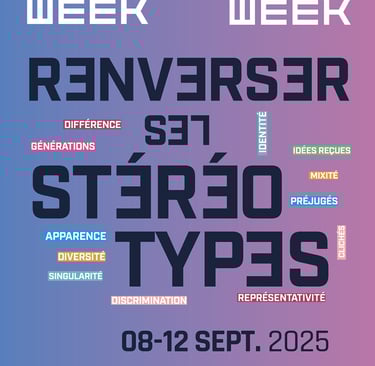


At the end of the jam, our project won the Best Sound Design Award.
After, we decided to enter the Les Chatons d’Or festival, where our game was selected as a finalist in the “Best Video Game” category.
Screenshots
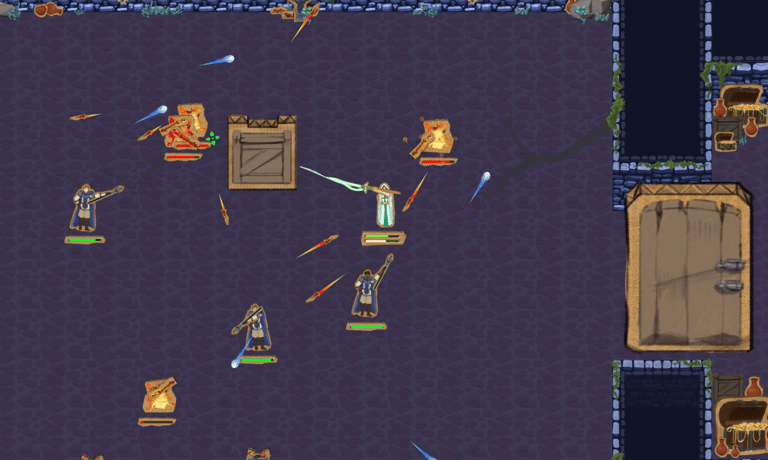
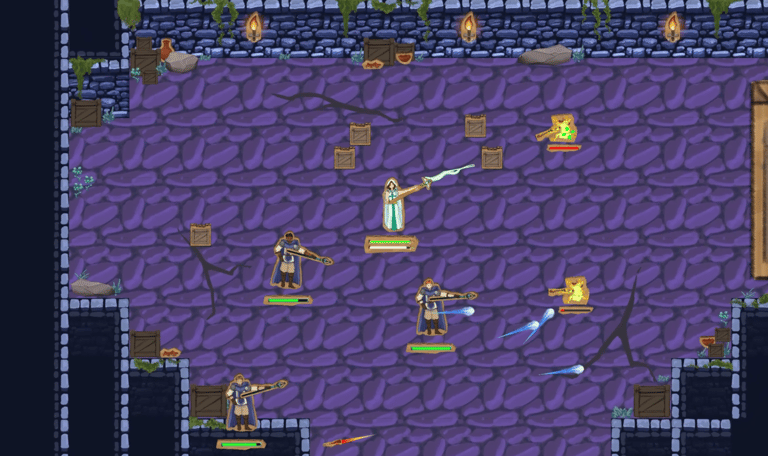
My Roles
Game Design


To fit the theme “Reverse Stereotypes”, I wanted to challenge a common stereotype in action hero games, where support characters are often women, and the stereotype that female gamers should take on the support role.
In Donjons & Cartons, a group of friends are playing a role-playing game and force their female friend to take on the support role. However, she decides to work around the limitations of her abilities and find alternative ways to defeat enemies, becoming the best player in the game.
concept scheme
Concept

Combat Design
I created the game's 3C technical documentation in Notion, intended for the programmers.
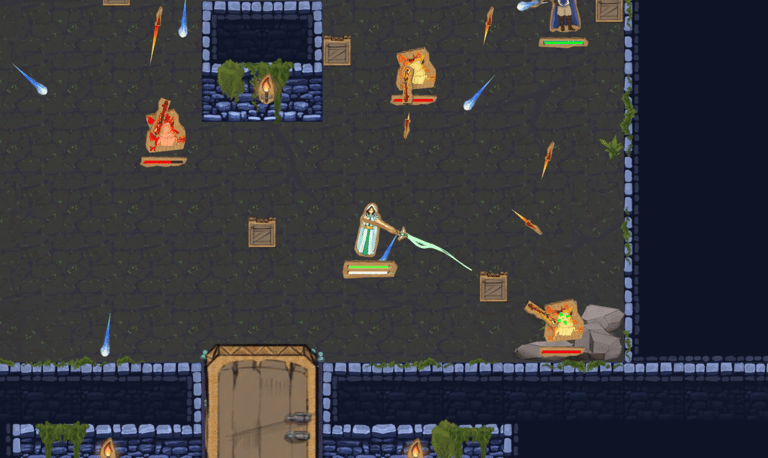
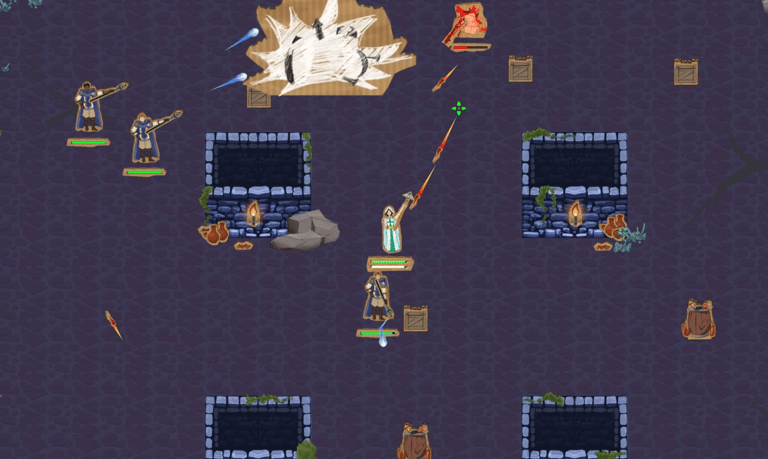
The player is equipped with a magic staff with several different uses:
Shoot a healing beam to restore allies' health.
The beam can enchant enemies, immobilizing them and increasing their size, making them easier to hit.
The beam can push boxes and explosive barrels, which can deal damage to enemies.
With this combat system in a top-down shooter, the gameplay relies less on shooting and more on positioning, as they must align themselves with objects in order to push them into enemies.
The design goal was to create a single ability with multiple uses, giving players freedom and creativity in combat.


Narrative Design
I contributed to the game's story and narrative structure.
I wrote all the dialogue for the intro cinematic, as well as all the in-game character barks.
I supervised the voice recording sessions in the studio and even contributed to the voice acting myself.

AI Design
I created several technical documents and scheme for the programmers, explaining the logic and behavior of the enemy and ally AI systems in the game.


Enemis:
Enemies detect allies or the player based on their detection range.
Enemies have a chance to switch targets, to give an effect of self-consciousness
While shooting, enemies can move randomly to make combat feel more natural and dynamic.
I created 4 enemy types by modifying their stats: Basic Enemis, SMG Enemis, Small Enemis, and Large Projectile Enemis.
The allie's AI shares the same overall logic as the enemies' AI.
I designed the allies to be ineffective without the player's assistance. Their accuracy is intentionally low, and they fire with a wide spread. Since the player cannot directly attack enemies, I wanted them to feel like a key element in the fight.
Each ally has its own "character", achieved by modifying their stats such as movement speed, fire rate, and health.
Allies:

System Design


There were many different elements and systems in the game, and we had to determine how they would interact with one another.
How does the healing beam interact with an ally, an enemy, a crate, or a barrel?
What happens when a crate or explosive barrel is pushed into an enemy, an ally, another crate, or another barrel?
What happens when a projectile hits the player, an ally, an enemy, a crate, or a barrel?
We had to answer all of these questions while staying consistent with the game's design intentions.


Level Design


Top View


All Rooms


N°1
N°2 ; N°3
N°4 ; N°5
N°6 ; N°7
N°9
N°10
N°11 ; N°12

Level Design Techniques

N°8
Boxes push tutorial
To show the player that their beam can interact with the environment by pushing boxes, I intentionally blocked the player inside a tunnel, with boxes blocking the allie's path. The player has to tinker to figure out how to move the boxes out of the way.
Explosif barril tutorial

I wanted to shwo the player that explosive barrels can be pushed into enemies to kill them directly. I therefore placed an explosive barrel in front of the arena entrance, with a short-range enemy positioned in front. The camera zooms out earlier, allowing the player to immediately see the enemy and understand that they can push the barrel into it.

Big box blocking the way
To further demonstrate that allies are helpless without the player's presence, I placed a large box blocking the path. The player is the only one capable of pushing this box by using their mana. This obstacle also serves as another type of “gate” within the level.

Explosion chain
To create a “wow moment”, I blocked a passage with a large explosive barrel surrounded by several smaller barrels. The player can figure out that they need to detonate the surrounding barrels to trigger a chain reaction, creating a satisfying moment.
Bulldozer box

This room contains a single box in the center, which the player must use as their primary weapon. They have to move around it to properly direct the box or use it as cover. I wanted to create a bulldozer-like feeling, with an object crushing everything in its path.

Level Art


For the level creation, we used a Tilemap system. I decorate the entire level using the tiles created by the Environment Artist.
Despite having a limited number of tiles, I tried to create a varied and visually distinct environment.
I also added several 2D assets to the rooms to further decorate the level.
Producing

As the Lead Game Designer, I also took on the role of Producer. I helped organize and manage the team, acting as a bridge between the different disciplines and keeping everyone aligned with the game's creative direction.
I created a HacknPlan board and an Asset List to organize and track tasks for each team.
I also made strategic production decisions and set deadlines to ensure we delivered a polished and complete game.


Walkthrough

Credits
Game Designer
Ralif TAZUTDINOV
Game Artists
Andréas MARTINS
Arthur PETIT
Jina DEFRANCE
Ibrahim MOHAMED IBRAHIM
Game Programmers
Liam GRAU
Marc LINDNER
Tyfenn SANDRIN
Sound Designer
Fleur BREUSSIN